

A client called me a few years back. Their QA scores looked solid — agents were hitting 87% on evaluations month after month. But CSAT was dropping, escalations were climbing, and nobody could explain the gap. When I dug into it, the answer was clear: they had monitoring. What they didn’t have was management or assurance. They were measuring everything and changing nothing.
That’s what happens when you treat these three terms as interchangeable. Quality monitoring, quality management, and quality assurance are distinct functions. They solve different problems, require different resources, and produce different results. Substituting one for another doesn’t just miss the mark — it creates the appearance of a working program while the real problems accumulate underneath.
Quality Monitoring: What It Actually Does
Monitoring is observation. You’re capturing interactions — calls, chats, emails — and evaluating what happened. A supervisor listens to a recorded call and scores it against a rubric. At scale, software handles that initial pass, flagging interactions by keyword, sentiment, silence duration, or talk ratio before a human reviewer is involved.
That’s the scope. Monitoring tells you what occurred. It does not change behavior. It does not drive process improvement. That’s not a weakness — it’s the boundary of what monitoring is built to do.
Monitoring answers the right questions: Did the agent use required compliance language? Was the call structure followed? Where are dead air problems concentrated? Which agents have handle time outliers?
Where it falls apart is when it’s treated as the complete QA program. You can evaluate 10,000 calls a month and produce detailed scorecards showing exactly where agents are struggling — and see zero improvement in actual performance if nobody acts on the data. I’ve seen operations with six QA analysts producing clean, thorough reports while the floor continued doing exactly what it was already doing.
The practical requirement for monitoring is this: capture interactions across every channel, score them consistently, and surface the right interactions for review. A flat 2% random sample across all agents doesn’t serve that goal. Targeted sampling — pulling interactions based on specific triggers like first call after training, compliance keywords, or sentiment flags — produces more actionable data from the same review effort.
Quality Management: The Operational Layer
Management is where monitoring data becomes action. It’s the coaching cadences, calibration sessions, accountability workflows, and tracking structures that convert an observation into a behavior change.
If monitoring answers what happened, management answers what happens next.
A working quality management system connects QA scores directly to individual coaching conversations. It keeps evaluators calibrated so a score of 78 from one analyst means the same thing as a score of 78 from another. It tracks whether agents are improving over time, not just where they scored on a given day. And it closes the loop — a failing score triggers a defined process with documented follow-through, not just a note that gets buried.
The failure I see most often here is the gap between data and action. Operations teams produce substantial QA data. That data goes into a report. The report goes to a team leader who is already running at capacity with scheduling gaps, attendance issues, and a queue to manage. The coaching conversation either doesn’t happen or happens without structure. Scores plateau. The program becomes a compliance checkbox.
The questions management should answer: Are agents improving after coaching? Are team leaders spending their coaching time effectively? Can we connect QA program activity to measurable changes in handle time, CSAT, or first call resolution?
In large operations, the ratio of coaches to agents makes individual coaching impractical without a system supporting it. You cannot manage quality at scale without a framework that makes coaching efficient and trackable. Quality management tools should connect directly to scoring data, give supervisors a structured way to document and track coaching sessions, and give operations leadership clear visibility into whether that coaching activity is producing improvement.
Quality Assurance: The Strategic Function
Quality assurance is the broadest of the three. It includes monitoring and management but extends further — into process design, standards calibration, compliance oversight, and ongoing evaluation of whether the QA program itself is producing the outcomes the business needs.
QA is not only about what agents do on interactions. It’s about whether your entire quality system is built to measure the right things and drive the right results.
A real QA function asks harder questions: Are our evaluation criteria aligned with what actually causes customers to escalate or churn? Are our standards keeping pace with regulatory requirements in the markets we operate? When a compliance failure or a spike in escalations occurs, can we trace it to a specific process gap rather than pointing at individual agents?
This is where most QA programs are weakest. Organizations stand up monitoring, attach a coaching workflow, and call the whole thing QA. But they never evaluate whether the program itself is working. They measure agent behavior without asking whether they’re measuring the right behaviors, or whether the metrics they’re tracking connect to the outcomes that matter.
A QA program that doesn’t feed back into how you train agents and design processes will gradually drift out of alignment with business reality. It produces increasingly detailed reports about an increasingly irrelevant set of metrics. Contact center QA tools need to support program-level analytics, not just interaction scoring — so you can identify patterns that reflect process failures, curriculum gaps, or compliance exposure, not just flag individual interactions that scored poorly.
How the Three Connect
Monitoring is the input. Management is the throughput. Assurance is the feedback loop.
In a smaller operation, one person handles all three functions. In a large BPO environment, these need distinct ownership. When you treat them as a single function, accountability disappears. Nobody owns the strategic layer. The program generates data, coaching happens sporadically, and nobody is asking whether any of it is moving the metrics that matter.
What to Ask When Evaluating Software
Most buyers shopping for quality monitoring or management tools are looking for a platform that covers all three functions. That instinct is correct. But the evaluation questions are different for each layer.
For monitoring: What channels does it capture? How does it prioritize which interactions get reviewed? What does the automated scoring cover, and how does its accuracy compare against human review?
For management: How does it connect scores to coaching workflows? Does it support calibration across multiple evaluators? Can a team leader see at a glance which agents need attention and what the coaching follow-through history looks like?
For assurance: What does program-level reporting look like? Can it distinguish systemic issues from individual performance problems? Does it produce the audit documentation that compliance and legal require?
A platform that handles monitoring well with a basic coaching module added on is not the same as a platform built to support all three functions. That gap tends to become visible about six months after implementation, when the monitoring data is clean and the performance numbers haven’t moved.
Where Automated Scoring Fits
A few years back, automated QA scoring was useful for initial flagging but required substantial human review to be reliable. The technology has changed. Tools like QEval™ now score 100% of interactions with accuracy rates that hold up against human review benchmarks. That means you’re no longer working from a 2 to 5% sample — you’re working from your complete interaction volume.
That changes the economics of monitoring considerably. It also changes what’s possible in the management layer, because when you can see every interaction, you can identify coaching priorities with greater precision than random sampling allows.
What it doesn’t change is the judgment requirement in management and assurance. Automated scoring tells you what happened across all your interactions. A supervisor still needs to determine what coaching to deliver, how to sequence it, and whether a pattern in the data reflects a process problem that individual coaching won’t address. Those decisions require context the scoring layer doesn’t provide.
The operations that get the most from automated QA tools are the ones that used the efficiency gain to strengthen management and assurance — not the ones that increased their monitoring volume without building the downstream functions to act on it.
You Need All Three. Most Operations Have One.
Quality monitoring tells you what’s happening in your interactions. Quality management turns that data into agent behavior change. Quality assurance ensures the whole system is measuring the right things and producing outcomes the business can use.
Without monitoring, you’re operating without data. With monitoring but without management, you have data and no action. With monitoring and management but without assurance, your program gradually drifts out of alignment with what the business actually needs — and you won’t notice until the gap is already expensive.
All three need to be in place. More importantly, each one needs clear ownership. The organizations that conflate these functions don’t end up with no QA program. They end up with a QA program that produces thorough reports and changes very little.
If you’re serious about building a QA program that actually moves performance, QEval™ was designed to support all three functions in one platform. Take a look at what that looks like in practice at etslabs.ai — or reach out directly. I’m happy to talk through what your operation actually needs.

Related Posts
 Manu Dwievedi
 Contact Center AI: Strategic Decisions Your Organization Must Make
Six strategic decisions contact center leaders must make before choosing AI, from outcomes and augmentation…
Read More
Automated Quality Management Explained: Building QA Programs That Scale
Manual QA covers 3-5% of calls. Automated quality management covers 100%. See how contact centers…
Read More
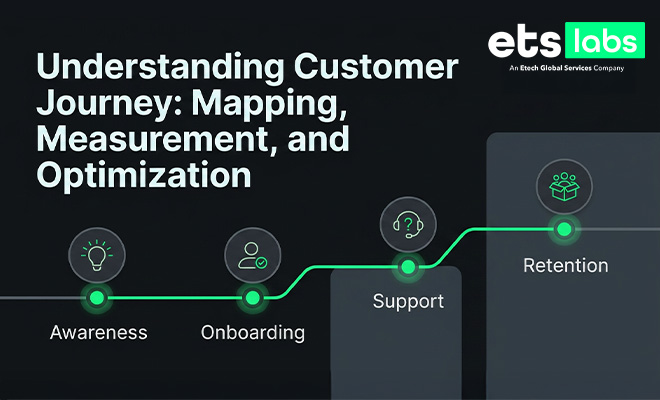
Understanding Customer Journey: Mapping, Measurement, and Optimization
A strategic guide to customer journey mapping and measurement — how to move from whiteboard…
Read More
Contact Us
Let’s Talk!
Choose Services