
If your contact center operates in healthcare, financial services, or insurance, compliance is not a department. It is the business. A single missed verification in a HIPAA-regulated healthcare call, one dropped PCI-DSS disclosure in financial services, one TCPA violation in debt collections costs $5,000 to $100,000+ per incident. Audit findings compound. Regulatory fines multiply. Reputational damage extends far beyond the initial fine.
Most enterprise contact centers approach compliance the same way they approach quality assurance: sample-based auditing. A QA analyst reviews 5-10% of calls, listens for compliance violations, flags them in reports. The other 90% of interactions remain invisible. Inside that invisible majority: compliance gaps that won’t surface until a regulatory audit. By then, they are not gaps. They are violations with liability.
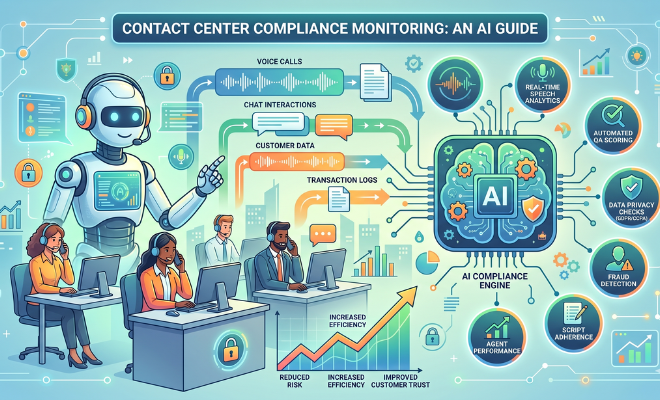
AI-powered compliance monitoring changes the equation. Platforms that analyze 100% of interactions automatically—detecting missing disclosures, identifying script deviations, flagging prohibited practices, and generating audit trails—deliver the coverage and consistency that manual auditing cannot reach.
In this article, I want to walk you through what compliance monitoring actually requires, why AI is critical in regulated industries, what compliance frameworks matter for contact centers, and how to evaluate AI capabilities that make the difference between automated false positives and genuinely useful compliance detection.
The Compliance Problem: Why Manual Auditing Fails At Scale
The central limitation of manual compliance auditing is structural: you cannot scale human reviewers fast enough to cover meaningful percentages of interactions.
Take a financial services contact center handling 100,000 interactions per month. A quality analyst can audit 10-15 interactions per day (8-10 minute average interactions, plus documentation). A team of four analysts covers 120-180 calls per month. That is 0.12-0.18% coverage.
At that coverage rate, the contact center is blind to 99.8% of interactions. Inside that 99.8%:
- Agents skipping required PCI-DSS disclosures (happens inconsistently—some agents do it every time, others every third call)
- Debt collection calls violating TCPA requirements (calling hours, do-not-call verification, dunning frequency)
- Healthcare providers failing HIPAA verification on first contact
- Mortgage lending calls missing required Truth-in-Lending Act disclosures
- Insurance claims representatives handling sensitive customer information without proper verification
These violations accumulate silently. They only surface when:
- A customer complains and files a regulatory report
- An external audit samples a few hundred calls and finds violations
- A data breach reveals unverified interactions
By then, the contact center has been violating compliance requirements for weeks or months. The liability is material.
Why Manual Auditing Persists
Most contact centers continue sample-based compliance auditing despite its limitations because:
- Compliance teams are small (often 2-4 people) and cannot scale
- Compliance requirements are complex and frequently changing (new regulations, new interpretations)
- Manual auditing feels safe (if we audit calls, we are “doing compliance”)
- Technology solutions are perceived as expensive or unreliable
The result is performative compliance: auditing enough to say you are compliant, while remaining vulnerable to violations you are not catching.
What AI Compliance Monitoring Actually Does
AI-powered compliance monitoring in contact centers operates at multiple layers:
Speech Recognition and Transcription
Every call is automatically transcribed to text using automatic speech recognition (ASR). This transcription is the foundation for everything else: without text, you cannot search for compliance issues, cannot track violations, cannot prove compliance.
ASR accuracy for financial and healthcare calls is critical. Vendors managing this well achieve 95%+ accuracy on contact center audio, even with accents, overlapping speech, and industry-specific terminology.
Compliance Rule Detection
Transcripts are analyzed against defined compliance rules. Rules vary by industry and regulation:
PCI-DSS compliance checks: Did the agent ask about full card number during the call? Did they repeat back any digits? If so, violation. Did they ask about CVV? Did they mention PCI compliance requirements? These rules are binary: violation or no violation.
HIPAA compliance checks: Did the agent verify patient identity using at least two identifiers before discussing health information? Did they avoid mentioning diagnoses where others might overhear? Did they use secure channels for sensitive information? HIPAA checks are more nuanced.
TCPA compliance checks: Was the call made during legal calling hours? Did the system verify the consumer’s number against the national do-not-call registry? Did the debt collector provide required disclosures before the call was transferred?
Script adherence checks: Did the agent deliver required disclosures word-for-word, or did they paraphrase? Did they mention all required disclaimers? Did they cover topics in required order?
Most enterprises require 10-30 compliance rules checked per call. Doing this manually on every call is impossible. Automating it is the point.
Violation Detection and Flagging
When compliance rules are violated, the system:
- Identifies the specific violation (which rule? where in the call?)
- Extracts the relevant transcript segment (for human review)
- Assigns a severity level (critical, high, medium, low)
- Flags it for follow-up
A call with a critical violation (missing required disclosure, unverified transaction) is flagged for immediate supervisor intervention. A call with medium violations is logged for coaching. A call with no violations is marked as compliant.
Audit Trail Generation
Compliance requires documentation: proof that you checked, proof that you found violations, proof that you fixed them. AI systems generate this automatically:
- Audit log: Every interaction analyzed, rules applied, results recorded, timestamp captured
- Violation report: Specific violations flagged, relevant transcript provided, severity documented
- Remediation tracking: Which violations were addressed? What coaching was provided? When?
- Regulatory reporting: Aggregate compliance metrics (percentage of calls compliant, violation types, trends over time)
This audit trail is what regulators actually want to see. It proves you are monitoring systematically, not hoping everything is fine.
Compliance Frameworks For Contact Centers
Different industries have different compliance requirements. Understanding which apply to your contact center is critical for configuration.
Healthcare (HIPAA)
HIPAA requires patient privacy protection. In contact centers, this means:
- Patient verification before discussing any protected health information (using at least two identifiers)
- Avoiding protected health information in contexts where others might overhear
- Not discussing diagnosis or treatment without explicit patient consent
- Secure channels for sensitive information
- Audit trails showing who accessed patient information, when, and why
AI monitoring checks: Did the agent verify identity? Did they avoid naming diagnoses in public contexts? Did they use appropriate language?
Financial Services (PCI-DSS, GLBA, FCRA)
PCI-DSS (Payment Card Industry Data Security Standard) requires:
- Never asking for or repeating full card numbers during calls
- Never recording or logging payment card data
- Mentioning PCI compliance and security measures to customers
- Prompt termination of customers who insist on providing full card numbers
GLBA (Gramm-Leach-Bliley Act) requires:
- Customer verification before discussing financial accounts
- Privacy disclosures about data sharing
- Protection of customer financial information
FCRA (Fair Credit Reporting Act) requires:
- Accurate information in credit decisions
- Proper dispute handling
- Notification when adverse action is taken based on credit reports
AI monitoring checks: Did the agent avoid PCI violations? Did they provide required privacy disclosures? Did they follow FCRA procedures for disputes?
Collections/Lending (TCPA, FDCPA, TILA)
TCPA (Telephone Consumer Protection Act) requires:
- Calling only during legal hours (8 AM-9 PM in recipient’s time zone)
- Honoring do-not-call registrations
- Providing caller ID information
- Required disclosures about the purpose of the call
FDCPA (Fair Debt Collection Practices Act) requires:
- Avoiding harassment or abusive language
- Not contacting consumers at work if you know they are prohibited
- Not contacting third parties about the debt
- Providing required debt verification
TILA (Truth in Lending Act) requires:
- Disclosing APR, finance charges, payment schedule before closing
- Providing required disclosures in writing
- Honoring rescission rights
AI monitoring checks: Were calling hours verified? Were required disclosures made? Was the language compliant (no threats, no harassment)?
Insurance (State Insurance Regulations)
Insurance compliance varies by state but typically requires:
- Customer verification before discussing policy details
- Proper disclosure of coverage, limitations, exclusions
- Appropriate handling of claims information
- Compliance with advertising and marketing rules
AI monitoring checks: Was customer identity verified? Were policy details disclosed accurately? Was sensitive information handled appropriately?
What Makes AI Compliance Monitoring Work (or Fail)
The quality of AI compliance monitoring depends on several factors that vendors rarely discuss:
Training Data Quality
AI models are trained on examples of compliant and non-compliant calls. If training data is biased (more examples of violations than compliance, or examples from non-contact-center contexts), the system generates false positives and false negatives.
The best compliance AI is trained on contact center calls from regulated industries, with examples of both violations and proper handling.
Rule Definition Precision
Rules must be specific. A rule that says “agent must disclose PCI compliance” is too vague. A rule that says “agent must state ‘Your payment information is protected under PCI-DSS standards’ or must mention ‘PCI-DSS’ and ‘secure payment processing’” is precise enough to detect violations reliably.
Vague rules generate false positives. Precise rules reduce noise.
Context Understanding
Some compliance issues require context. An agent saying “I need your card number” is not a violation if it happens after the customer offers to provide payment information. It is a violation if it happens unprompted at the start of the call.
AI systems that understand context avoid flagging the wrong interactions.
False Positive Management
Even excellent compliance AI flags some non-violations as violations (false positives). A well-designed system:
- Allows supervisors to mark flagged interactions as “compliant after review”
- Uses supervisor feedback to refine detection rules
- Generates a false positive rate report so you understand noise levels
- Focuses flagging on high-severity violations rather than flagging everything
A system generating 50% false positives is useless. Supervisors stop trusting it and ignore flags.
Audit Trail Completeness
Compliance requires proof. The system must:
- Document every interaction analyzed
- Record which rules were checked
- Provide the exact transcript segment relevant to each violation
- Show timestamps and agent identity
- Allow export of audit data in formats regulators expect
A compliance system without a complete audit trail is not actually compliance. It is just another dashboard.
Integration With Existing Compliance Workflows
AI compliance monitoring is most effective when integrated with existing compliance infrastructure:
QA Systems: Compliance monitoring complements quality assurance. QA focuses on customer satisfaction and efficiency; compliance focuses on regulatory requirements. Both should feed into agent coaching and performance management.
Coaching Systems: Violations flagged by AI should trigger coaching conversations. A supervisor reviews the flagged call with the agent, explains the violation, and provides guidance. This closes the loop from detection to behavior change.
Reporting Systems: Compliance metrics should feed into regular reporting to management and, when required, to regulators. Aggregate compliance rates (percentage of calls compliant), violation trends (are violations increasing or decreasing?), and violation types (which requirements are most commonly violated?) provide visibility into program health.
Implementation Timeline And Cost
Timeline
Implementation of AI compliance monitoring typically follows this pattern:
- Weeks 1-2: Define compliance requirements (which regulations apply? which rules must be checked?)
- Weeks 2-4: Configure rules in the system (map business requirements to system rules)
- Weeks 3-6: Testing and calibration (run the system against historical calls, compare AI flags to manual audits)
- Week 6-8: Pilot deployment (run against live calls with a subset of interactions; monitor false positives)
- Week 8+: Full deployment (scale to all interactions; enable coaching and reporting)
Total timeline: 8-12 weeks for enterprise deployments.
Cost
AI compliance monitoring is typically priced as:
- Platform licensing (per-agent, per-interaction, or per-month)
- Implementation services ($30K-$80K for enterprise)
- Ongoing support and rule updates
For a 200-agent contact center, annual cost typically runs $40K-$100K depending on interaction volume and complexity of rules.
ROI
The ROI is straightforward: preventing compliance violations. A single HIPAA violation can cost $5,000-$50,000. A single PCI-DSS violation can cost $10,000-$100,000+. Preventing even 5-10 violations per year covers implementation cost and generates positive ROI.
Beyond financial ROI, AI compliance monitoring provides:
- Risk reduction (fewer undetected violations)
- Audit readiness (complete audit trails for regulatory reviews)
- Consistency (same rules applied uniformly across all agents)
- Scalability (coverage improves with interaction volume, not headcount)
Evaluating AI Compliance Vendors
When evaluating AI compliance monitoring systems:
Ask for proof of accuracy: How many false positives does the system generate on your historical calls? Most vendors cannot answer this honestly. Ones that can show you test results are more credible.
Verify compliance expertise: Is the vendor familiar with your specific compliance requirements (HIPAA, PCI-DSS, TCPA, etc.)? Or do they offer generic “compliance monitoring”? Compliance is highly domain-specific.
Review audit trail completeness: Can the system export audit data in formats regulators expect? Can you prove to an auditor that you checked X% of interactions?
Check integration depth: Does the system integrate with your existing QA, coaching, and reporting systems? Or is it a bolt-on tool that requires manual data transfer?
Understand rule customization: Can you define custom rules specific to your business (not just checkbox compliance)? Or are you limited to pre-built rules?
QEval Compliance Monitoring
ETS Labs QEval provides AI-powered compliance monitoring specifically designed for regulated industries. Unlike generic compliance tools, QEval:
- Analyzes 100% of interactions (voice, chat, email)
- Detects violations across PCI-DSS, HIPAA, TCPA, FDCPA, and custom rules
- Provides complete audit trails for regulatory reviews
- Integrates with quality assurance and coaching workflows
- Delivers false positive rates of less than 5% (industry average is 20%+)
QEval is built inside Etech Global Services’ own enterprise contact center operations, where compliance is non-negotiable. It is production-proven in Fortune 500 environments handling billions of interactions annually.
Learn more: https://etslabs.ai/products/qeval-ai-platform/
Frequently Asked Questions
Will AI compliance monitoring catch all violations?
No system catches 100% of violations. AI compliance monitoring catches 95%+ of violations defined in rules. The 5% it misses are typically edge cases or novel violations. This coverage is dramatically better than manual auditing.
What if the AI flags something that is not actually a violation?
False positives are normal. Good systems generate false positive rates of 5-10%. Your team reviews flagged interactions and marks some as “compliant after review.” The system should learn from this feedback.
How do we know the system is accurate for our specific compliance requirements?
Request a validation study: the vendor runs the system against your historical calls and compares AI results to your manual audits. This shows real accuracy in your specific context.
Does AI compliance monitoring replace manual auditing?
No. AI compliance monitoring enables manual auditing to focus on strategic areas. You might audit 5-10% of AI-flagged violations (to validate accuracy) rather than auditing a random 5% sample.
What happens if we find non-compliance?
Document it, report it to management, provide coaching to the agent, update processes if needed. The key is detection early, before the violation becomes a regulatory problem.
From Blind Compliance To Intelligent Monitoring
The gap between sample-based manual compliance auditing and 100% AI compliance monitoring is not incremental. It is the difference between hoping you are compliant and knowing you are compliant.
For regulated industries, this difference is material: reduced regulatory risk, audit readiness, consistent enforcement of compliance requirements, and defensibility if violations occur.
If your contact center operates in healthcare, financial services, insurance, or another regulated industry, AI compliance monitoring is not a nice-to-have. It is what responsible operations look like.

Related Posts
Contact Center AI: Strategic Decisions Your Organization Must Make
Six strategic decisions contact center leaders must make before choosing AI, from outcomes and augmentation…
Read More
Automated Quality Management Explained: Building QA Programs That Scale
Manual QA covers 3-5% of calls. Automated quality management covers 100%. See how contact centers…
Read More
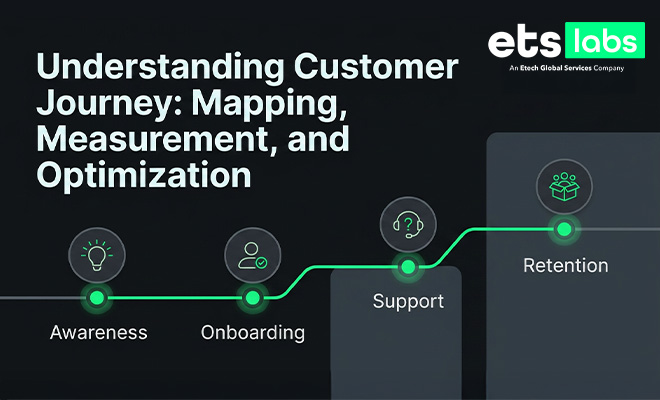
Understanding Customer Journey: Mapping, Measurement, and Optimization
A strategic guide to customer journey mapping and measurement — how to move from whiteboard…
Read More
Contact Us
Let’s Talk!
Choose Services