
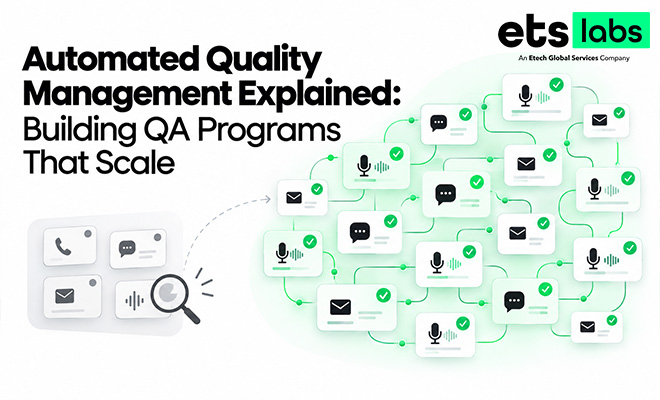
Manual quality monitoring typically covers three to five percent of calls. Automated quality management covers one hundred percent. That gap determines whether a quality program catches problems at scale or misses systemic issues entirely until they show up in churn, compliance findings, or customer complaints.
The economics are straightforward: hiring enough QA staff to manually score every interaction is not a budgeting challenge, it’s a mathematical impossibility at any meaningful scale. Automation changes that equation. This guide explains how automated quality management actually works, why it matters now more than it did a decade ago, and what to evaluate when selecting a solution.
The Manual vs. Automated QA Problem
Manual quality assurance has three structural limitations. Sample size caps out around three to five percent of interactions, which means the vast majority of customer conversations are never reviewed by anyone. Time lag means interactions are typically scored days after they happen, long after the agent has moved on and the customer relationship has already been shaped by whatever occurred. And consistency suffers because different QA specialists apply the same rubric differently, introducing variation that has nothing to do with actual agent performance.
The math makes the scale problem concrete. A 100-agent team handling 50 calls per agent per day generates 5,000 calls daily. At 15 minutes per manual score, reviewing even a modest sample consumes hundreds of QA hours a day — reviewing all of them is simply not possible with a human-only model.
Manual QA worked reasonably well for smaller teams with standardized scripts and simple compliance requirements. It doesn’t work as well now because operations have become omnichannel — voice, chat, and email all need coverage — agents increasingly operate with more autonomy in how they handle calls, regulatory requirements have grown more complex, and customer expectations for consistent service have risen. Sampling fails precisely because rare but serious issues don’t show up in a three percent slice, and compliance gaps hide comfortably in the ninety-seven percent that never gets reviewed.
What Is Automated Quality Management?
Automated quality management is the systematic scoring and evaluation of customer interactions using rules, algorithms, and AI rather than manual review. Three general approaches exist: rule-based systems that trigger on specific keywords or events, AI-based systems that recognize broader patterns in conversation and behavior, and hybrid systems that combine both.
What gets scored typically falls into four categories: compliance (were required disclosures or steps present), quality (was the approach and technique sound), customer perception (sentiment and effort signals within the conversation), and agent performance (consistency, product knowledge, and soft skills).
The output of a well-built automated QA system is every interaction scored immediately, with feedback data available in near real time rather than days later. It’s worth being clear about what automation does and doesn’t replace: it doesn’t replace coaching. What it does is identify which interactions need coaching and precisely why, turning a vague sense that “quality could be better” into specific, evidence-backed coaching moments.
How Automated QA Works
The mechanics follow a consistent pipeline. Calls and chats are recorded and transcribed — speech-to-text for voice, direct text capture for chat and email. The transcript is then analyzed against defined criteria: compliance rules, quality standards, and behavioral benchmarks. A scoring mechanism assigns points based on which criteria were met or missed, calculates an overall score, and identifies the specific factors that contributed to it.
Interactions get categorized by outcome — compliant or non-compliant, high-quality or low-quality, positive or negative sentiment — and specific key moments get flagged, such as a missed required disclosure or a spike in customer frustration at a particular point in the call. Scores and supporting detail then get distributed immediately to the agent, their manager, and the QA team, and individual scores roll up into team, shift, location, and process-level performance views.
In a well-implemented system, the entire pipeline from call completion to visible feedback happens within minutes rather than days — a fundamentally different feedback loop than the one manual QA has ever been able to offer.
Why Automated QA Changes Operations
The shift from sampling to full coverage changes more than just the numbers. Moving from three to five percent coverage to one hundred percent removes sampling bias entirely — patterns that were invisible in a small sample become immediately visible across the full population of interactions.
Feedback speed accelerates the agent learning curve. Same-day feedback, instead of feedback delivered five to ten days after the fact, means agents can correct a behavior before it repeats dozens more times. Consistency improves because the same criteria apply to every interaction, removing the variation introduced by different human scorers. Trends that used to take months to surface — “every agent on first shift is missing the same compliance step” — become visible almost immediately, giving managers the ability to intervene in-shift rather than after the fact.
The cost structure shifts from labor-intensive to technology-enabled, and the same effort now covers fifty agents or five hundred equally well. For regulated industries, the ability to say “we monitor every interaction” rather than “we monitor a sample and hope” is a materially different compliance posture. And coaches gain precision — instead of general performance impressions, they know exactly which moments in which calls need attention and why.
Key Evaluation Criteria for Automated QA Solutions
Not all automated QA solutions are built the same way, and the differences matter. Accuracy is the foundation — how well does the system identify both compliance and quality issues when measured against gold-standard manual scoring? A reasonable bar is 85% or higher accuracy on compliance items and 75% or higher on more subjective quality factors.
Explainability is critical, particularly in regulated industries: can you see why the system scored an interaction the way it did, and trace the specific reasoning back to the transcript? Speed matters too — industry standard is same-day scoring, with faster implementations delivering results within hours or even minutes of the interaction ending.
Implementation speed is its own evaluation criterion. A solution that takes months to become operational undermines much of the value proposition; the right benchmark is weeks, not months, accounting for your own team’s bandwidth to support the rollout.
Configuration flexibility matters as much as raw capability — can you build custom scoring rules that reflect your actual business model, or are you locked into vendor presets that approximate but don’t match your operation? Omnichannel capability deserves scrutiny as well, since many solutions perform well on voice but poorly on chat or email, leaving significant coverage gaps in digital-first operations.
Beyond compliance, does the system capture customer emotion and agent technique through sentiment and behavioral analysis? Does it integrate with your existing coaching platform or workforce management system, or does it create a new data silo? And can managers and coaches understand and trust the scores without extensive training — does the system explain itself in plain language rather than opaque scores? Finally, for regulated industries, full audit trail capability — the ability to demonstrate exactly what was scored, when, and why — is often a hard requirement rather than a nice-to-have.
Implementation Considerations
A pilot approach is the right starting point for most organizations: begin with one team or process, validate scoring accuracy against manual review, refine the rules, and then scale. This is also a significant change management exercise, not just a technology rollout — the QA team’s role shifts from scoring calls by hand to analyzing patterns and coaching based on automated output, which requires training and a genuine mindset shift.
Managers need coaching training to act effectively on automated feedback. Automation surfaces the issues; people still have to solve them. Agents are often initially uncomfortable with the idea of one hundred percent monitoring, and transparency about what’s being scored and why — framed clearly as a coaching tool rather than purely a compliance mechanism — meaningfully improves adoption.
Integration with workforce management, CRM, and coaching platforms reduces manual work and should be scoped early rather than treated as an afterthought. Ongoing scoring calibration — periodically checking automated scores against manual review samples — keeps accuracy high over time as business rules and agent behavior evolve. A realistic deployment timeline runs twelve to sixteen weeks: roughly two weeks for setup, four weeks for pilot and calibration, six weeks for phased rollout, and two weeks for stabilization.
Common Mistakes
A handful of mistakes account for most disappointing automated QA implementations. Automating a poorly designed scoring rubric simply scales the same flaws faster — garbage criteria in, garbage scores out. Assuming full automation means no manual review is ever needed again removes an important accuracy check; periodic audits remain necessary. Failing to train managers to act on the insights the system generates leaves valuable data sitting unused. Expecting an immediate jump in quality scores ignores the reality that coaching and behavior change lag behind data availability by weeks or months. And ignoring agent pushback about being monitored on every call, rather than addressing it directly and transparently, undermines adoption regardless of how good the underlying technology is.
What Changes for the QA Team
One detail worth naming directly: automation does not eliminate the QA function, but it does change what that function spends its time doing. In a manual model, QA specialists spend most of their day scoring calls one at a time. In an automated model, that scoring happens continuously in the background, and the team’s time shifts toward analyzing patterns across the full population of scored interactions, investigating anomalies the system flags, calibrating the scoring rules as the business changes, and working directly with managers on coaching strategy.
This is generally a better use of a QA specialist’s judgment and experience than manually scoring a small sample of calls — but it’s a real shift in day-to-day work, and it should be planned for explicitly rather than assumed to happen automatically once the technology is in place. Teams that treat the transition as “the software does the scoring now, so the QA team’s job is basically done” tend to underuse both the technology and the people, ending up with data that nobody is positioned to act on.
The Bottom Line
At meaningful scale — several hundred agents or more — manual QA isn’t really a strategic choice point anymore; it’s simply not achievable. Automation becomes the only economically viable path to full-coverage quality monitoring. The right way to think about the relationship between the two is straightforward: automated QA identifies where the coaching opportunities are, QA teams and managers execute the coaching, and business outcomes follow from that combination — not from the technology alone.
If you’re evaluating your current quality program against the framework above, the questions worth asking are direct: What percentage of interactions do we actually review today? How long does feedback take to reach an agent? Can we explain, in plain language, why any given interaction was scored the way it was? QEval® was built around those exact questions, delivering full-coverage, explainable scoring across voice and digital channels with implementation timelines measured in weeks rather than quarters.
Frequently Asked Questions
What percentage of calls does automated QA actually score?
A well-implemented automated QA platform scores 100% of interactions across voice and digital channels, compared to the 3-5% typical of manual sampling programs.
Does automated QA replace human QA analysts?
No. It changes what they spend their time on — shifting from manually scoring a small sample of calls to analyzing patterns, calibrating scoring models, and coaching based on full-coverage data. Complex, ambiguous, or high-stakes interactions still benefit from human judgment.
How accurate is AI-based quality scoring compared to manual scoring?
A reasonable benchmark is 85%+ accuracy on compliance items and 75%+ on more subjective quality factors, measured against gold-standard manual review. Accuracy should be validated through a calibration period before full deployment, and checked periodically afterward.
How long does it take to implement automated quality management?
A realistic enterprise timeline runs 12-16 weeks end to end: setup, pilot and calibration, phased rollout, and stabilization. Some platforms, including QEval, are built to deploy in under 30 days for well-scoped environments.
How is QEval different from other automated QA platforms?
QEval was built and proven inside Etech Global Services’ own enterprise contact center operations, processing over 2 billion interactions annually, before being made available as a standalone platform — so it’s tested against real operational constraints, not just demo conditions.

Related Posts
Contact Center AI: Strategic Decisions Your Organization Must Make
Six strategic decisions contact center leaders must make before choosing AI, from outcomes and augmentation…
Read More
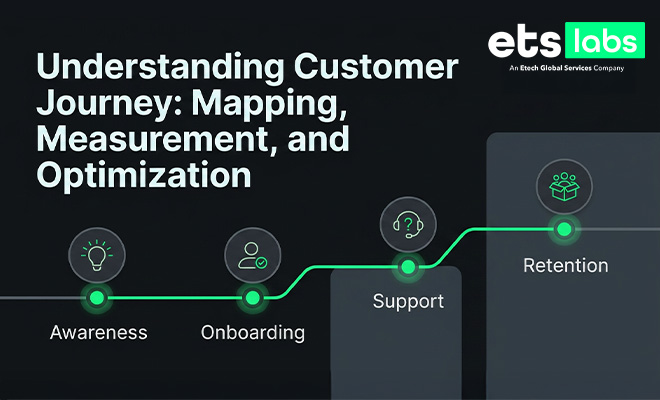
Understanding Customer Journey: Mapping, Measurement, and Optimization
A strategic guide to customer journey mapping and measurement — how to move from whiteboard…
Read More
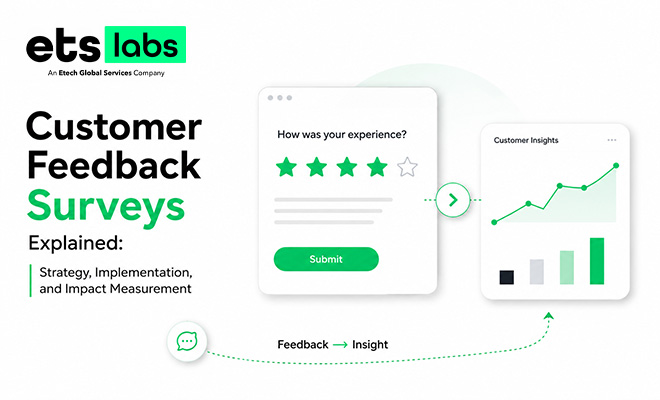
Customer Feedback Surveys Explained: Strategy, Implementation, and Impact Measurement
A practitioner’s guide to customer feedback surveys — types, strategy, implementation, and how to turn…
Read More
Contact Us
Let’s Talk!
Choose Services