
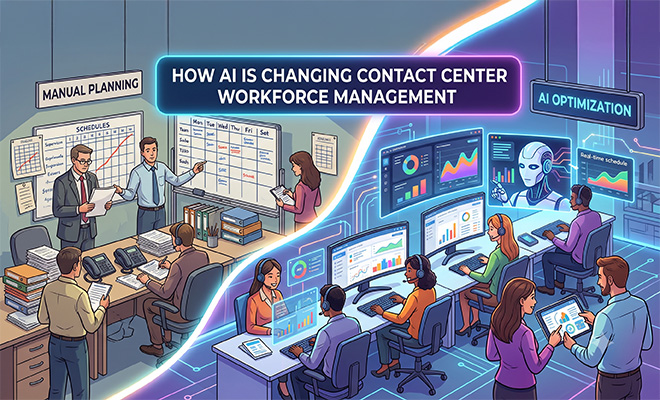
The math running most contact center schedules was published in 1917. The interactions it schedules were not.
What is AI in contact center workforce management?
AI in contact center workforce management is the application of machine learning models to forecasting, scheduling, intraday reallocation, and agent performance development. Unlike rule-based WFM systems, AI-driven approaches update staffing decisions continuously, based on real-time interaction data, agent behavioral patterns, and demand signals drawn from live queue data.
KEY TAKEAWAYS
- Legacy WFM still runs on Erlang C, a queuing formula published in 1917 that assumes Poisson arrivals, exponential service times, and zero abandonment. Multichannel demand, chat concurrency, and skill-based routing violate all three.
- The workforce being scheduled has changed too: AI agents now absorb the simple contact floor, which concentrates complexity in human queues, pushes handle time distributions right, and makes containment and escalation rates first-class forecasting inputs.
- The quality signal feeding the schedule matters more than its volume. Explainable, evidence-pinned scoring that analysts can interrogate, held to a contractual accuracy SLA, is what turns quality data into a staffing input anyone will act on.
- Plan a 4 to 8 week data readiness phase before model training. Full platform replacement is not required; AI integrates onto existing stacks through API.
- ROI is measurable at 90 days across forecast MAPE, schedule adherence, average handle time, and first contact resolution, provided a pre-deployment baseline exists.
Workforce management was designed around a specific set of operating assumptions, and those assumptions have a birthday. The Erlang C formula underneath most staffing calculations was published by Danish mathematician A.K. Erlang in 1917 to size telephone operators for the Copenhagen Telephone Company. It is elegant math, and it makes three assumptions worth naming precisely: arrivals follow a Poisson process, service times are exponentially distributed, and no caller ever abandons the queue. Erlang knew the abandonment assumption was wrong; the industry has spent a century patching around it, from Erlang A’s abandonment modeling to the simulation engines that skill-based routing forced on the market when closed-form math stopped fitting.
Modern operations violate all three premises daily. Chat agents run two or three concurrent sessions, which breaks the single-server queue model outright. Digital channels arrive in bursts that are anything but Poisson. And the deepest change is in who is being scheduled: AI agents now absorb the simple contact floor, which means the interactions left for humans are disproportionately the complex, emotional, exception-heavy tail. Handle time distributions shift right and widen. Containment rates and escalation flows become forecasting inputs as fundamental as arrival curves. A staffing model that does not see the AI side of the floor is forecasting a contact center that no longer exists.
The pressure to fix this is not theoretical. In a Gartner survey published in February 2026, 91% of customer service leaders reported pressure to implement AI this year, and 75% reported larger AI budgets than the prior year. This post covers what the shift to AI-driven WFM requires in practice, where implementations fail, and how to evaluate whether a given approach will deliver measurable results.
Market context: Gartner press release, February 2026, survey of 265 service and support leaders. Not ETS Labs data.
Where legacy WFM breaks down
Legacy WFM platforms were architected for environments where volumes were predictable, handle times were consistent, and quality feedback arrived on a weekly cycle. The scheduling engines are genuinely mature. The assumption structures underneath them do not transfer to variable, multichannel operations. Three failure modes appear consistently.
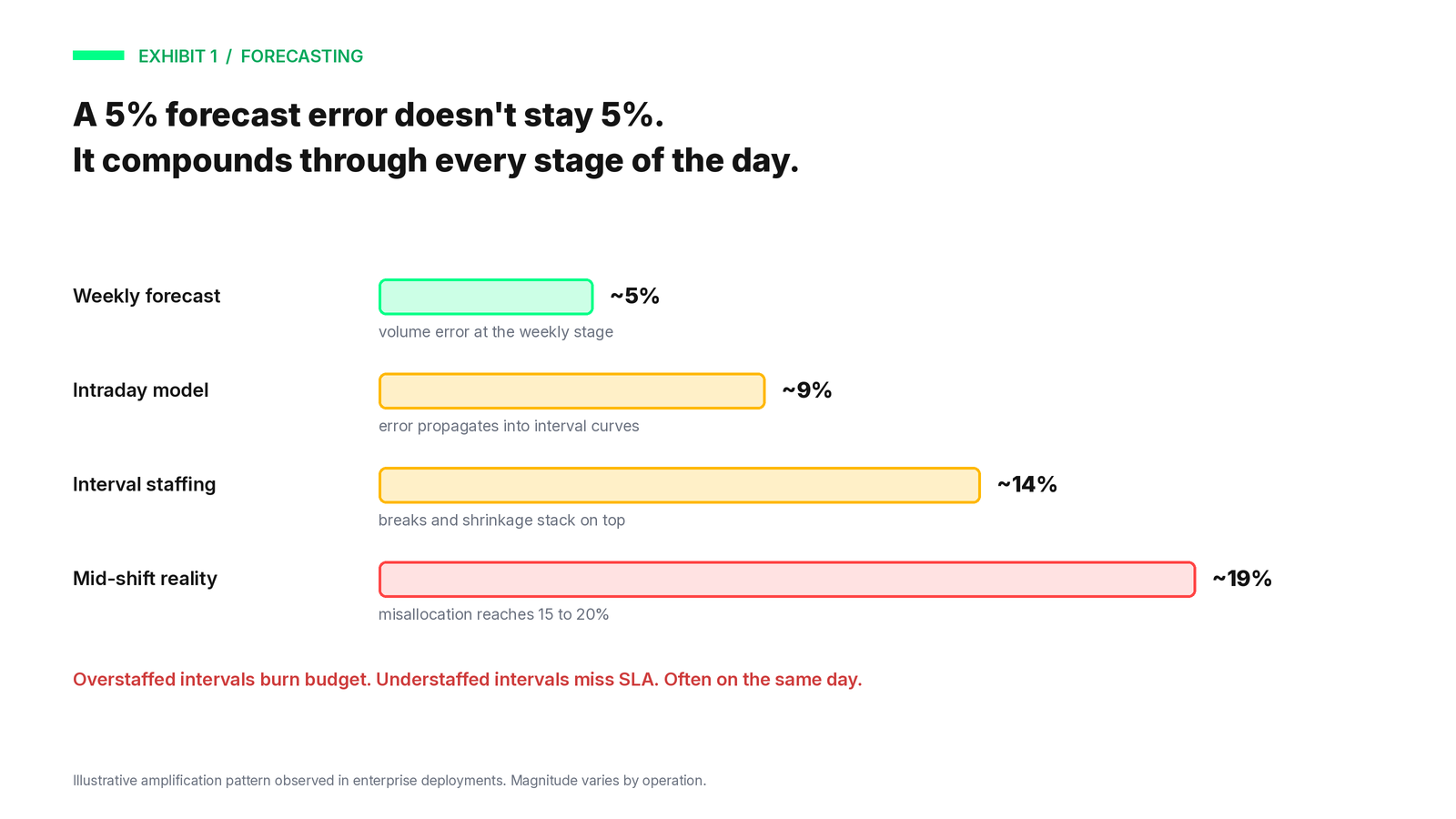
1. Forecast error compounds. A 5% volume error at the weekly forecast stage does not stay at 5%. As it propagates through intraday modeling, staffing intervals, and break scheduling, downstream misallocation can reach 15 to 20% by mid-shift. That produces overstaffed intervals that burn budget and understaffed intervals that miss SLA, often in the same day.
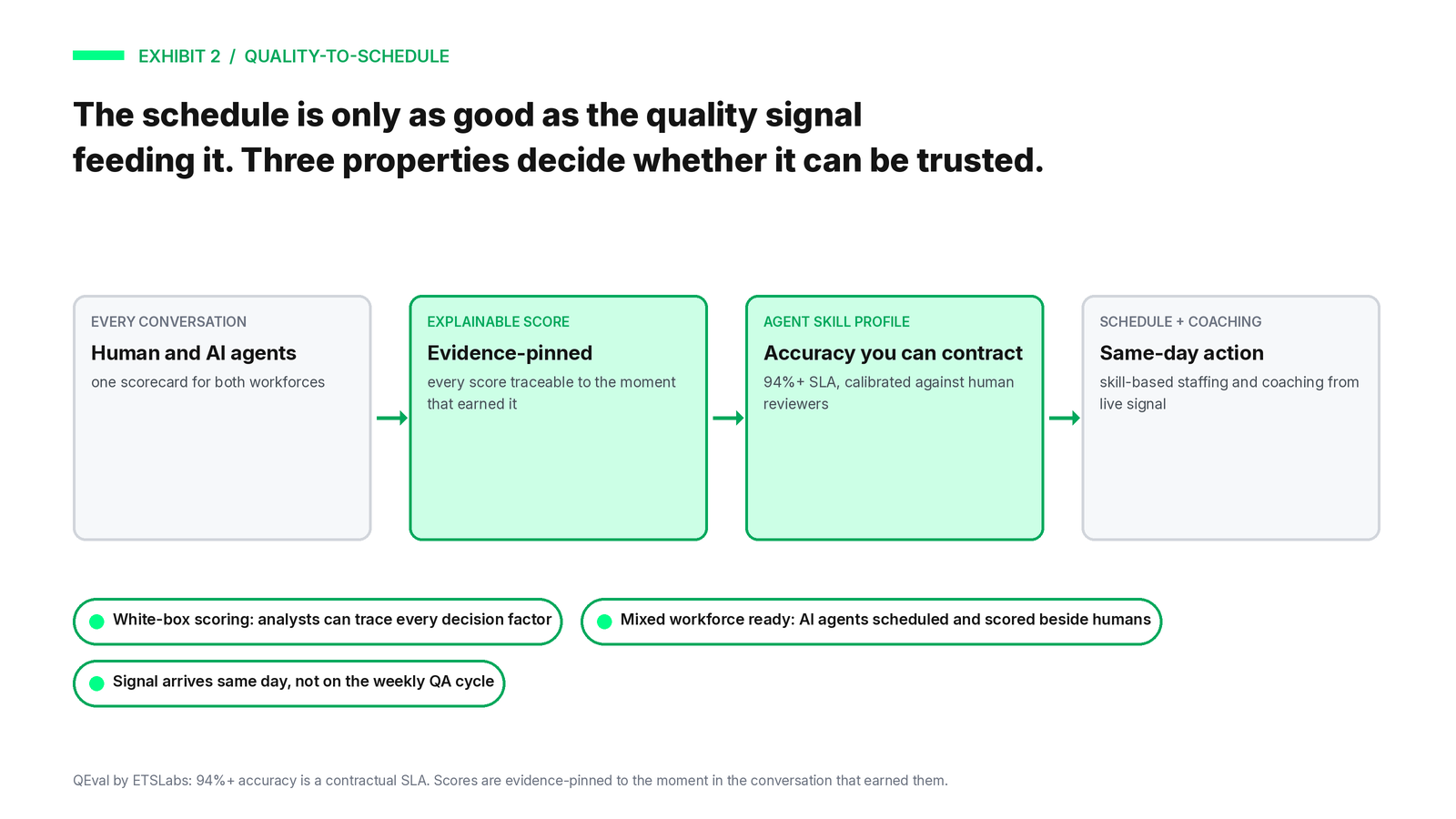
2. The quality signal never reaches the schedule. In most operations, quality data and scheduling data live in different systems on different clocks. QA results arrive on a weekly cycle; staffing decisions are made in fifteen-minute intervals. Even where quality scores exist, two properties usually disqualify them as scheduling inputs: nobody has contracted their accuracy, and nobody can explain them. A skill profile built on scores an analyst cannot interrogate, produced by a model whose accuracy nobody stands behind, will not survive its first argument with a floor supervisor. The signal has to be explainable, evidence-pinned to the conversations that produced it, and accurate enough to write into an SLA before scheduling logic can lean on it.
3. Intraday management is reactive. A volume spike gets noticed by a supervisor, escalated to a WFM analyst, and resolved by manual reallocation. By the time the recommendation reaches the floor, the peak has passed. The downstream cost shows up as budget variance, SLA miss patterns, and attrition: industry surveys put annual agent turnover between 31% and 39% (Metrigy measured 31.2% in 2024; NICE’s 2025 employer survey reported 39%), and schedule unpredictability is a documented contributor.
Market context: Metrigy 2024 research; NICE, Managing the Modern Contact Center: Current Employer Trends 2025. Not ETS Labs data.
Why bolt-on AI modules fall short
Most established WFM platforms have added AI forecasting modules or analytics dashboards. The limitations are structural, not cosmetic.
First, data fragmentation. Interaction data sits across separate systems: QA scores in one platform, CRM records in another, ACD logs in a third. AI models operating on any single source work from partial information, and a forecasting module that cannot see quality and skill data is optimizing half the problem.
Second, explainability. When an AI recommendation conflicts with a WFM analyst’s judgment and the analyst cannot trace the decision factors, one of two things happens: blind acceptance or blanket rejection. Both destroy the value of the system. Analysts carry real domain expertise; a system that cannot show its reasoning cannot earn their engagement.
| Dimension | Standard WFM | Production AI approach |
| Workforce modeled | Human agents only | Humans and AI agents, one scorecard, one staffing model |
| Forecasting method | Static historical curves, weekly batch | ML on rolling data, updated intraday |
| Intraday adjustment | Manual, significant lag | Model-triggered, minutes not hours |
| Quality signal | Weekly cycle, accuracy unverified | Same-day, evidence-pinned, 94%+ contractual accuracy |
| Explainability | Opaque scoring | White-box, traceable decision factors |
| Integration | WFM, QA, CRM as silos | API data fabric, no rip-and-replace |
| Time to value | 12 to 18 months | 30 to 90 days after data readiness |
Replacing a mature scheduling engine carries migration risk most operations cannot absorb. The practical path keeps the existing engine as the execution layer and adds an AI inference layer through API-based data pipelines: ML forecasting on full interaction distributions, explainable quality scoring, and real-time reallocation triggers.
How it works in production: six steps
AI-driven WFM is not a software install. It requires coordinated changes across data ingestion, models, process, and governance. Organizations that treat it as a deployment without addressing the underlying data and process conditions see limited results.
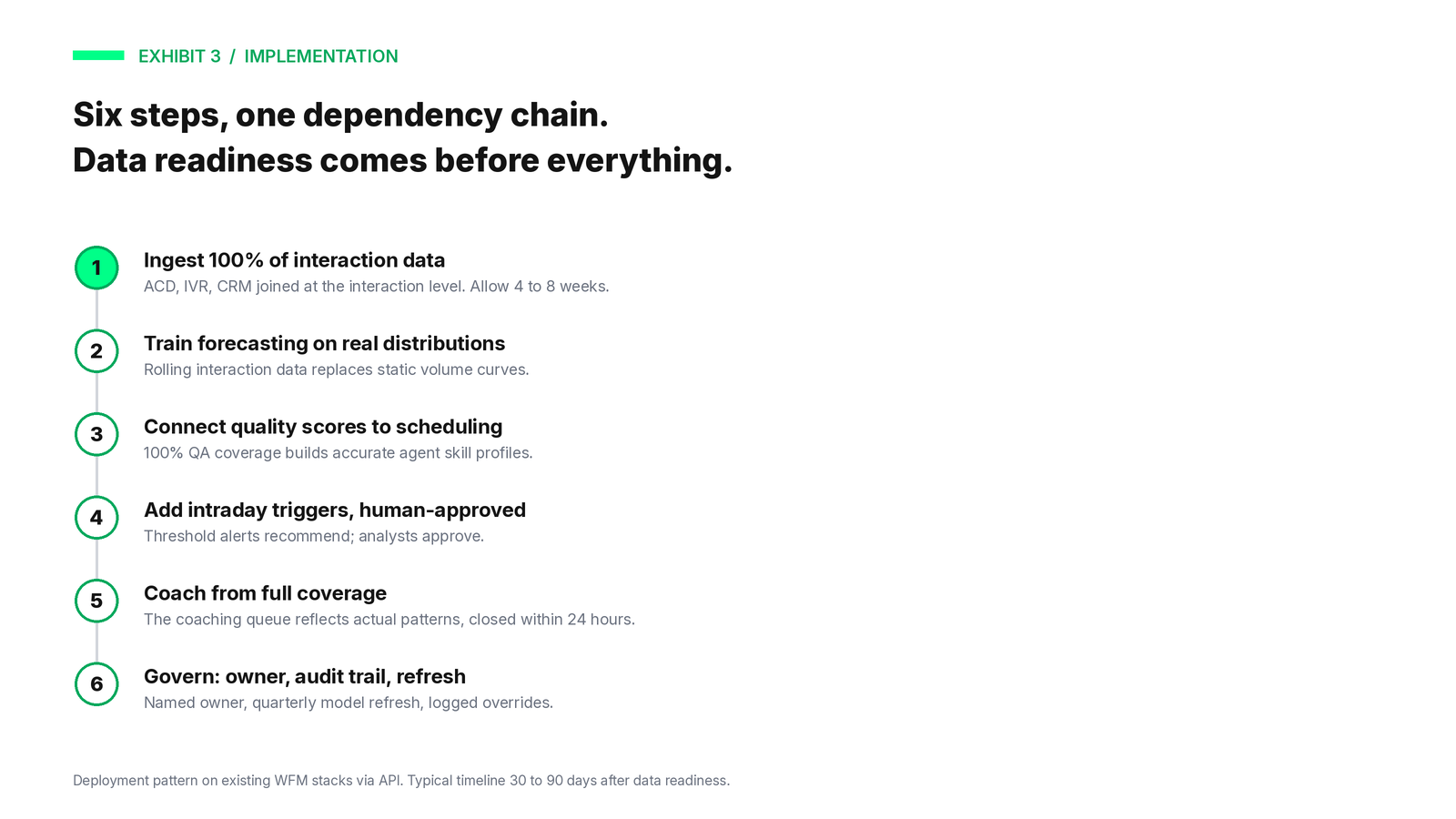
Step 1: Establish 100% interaction data ingestion. Connect ACD, IVR logs, and CRM into one pipeline. Model quality depends entirely on data completeness. This step is where timelines slip: budget 4 to 8 weeks of data readiness, especially where CRM and ACD records are not yet joined at the interaction level.
Step 2: Build forecasting on actual interaction distributions. Replace static volume curves with ML models trained on rolling data: real arrival patterns, handle time distributions, and channel mix. For reference, the widely used industry benchmark for forecast accuracy is a MAPE of about 5% for large agent groups and about 10% for small ones. Our production deployments target the 5 to 8% range in stable environments; high-seasonality operations need more frequent retraining.
Step 3: Connect quality monitoring to scheduling logic. This is where the differentiated work happens, and it depends on three properties of the quality signal rather than its volume. First, one scorecard across the whole floor: QEval by ETS Labs scores human agents and AI agents against the same rubric, so skill profiles cover the entire mixed workforce, not just the human half. Second, evidence-pinning: every score traces to the specific moment in the conversation that earned it, which is what lets an analyst interrogate a skill profile instead of taking it on faith. Third, contracted accuracy: 94%+ is an SLA in the MSA, calibrated against human reviewers, not a marketing adjective. Skill profiles with those three properties are staffing inputs; without them, they are dashboard decoration.
Step 4: Implement intraday triggers with human approval. Define threshold conditions, for example a 10% volume variance sustained over 15 minutes, that generate a reallocation recommendation for analyst sign-off. Human-in-the-loop is not a training wheel; logged overrides improve the model, and analyst judgment catches what models miss.
Step 5: Close the coaching loop from live signal. Scores that arrive with the evidence attached change what coaching is. The supervisor opens the exact moment in the conversation, the agent sees the same thing, and the conversation is about behavior, not about whether the score is fair. Connected to scheduling, this becomes a loop: score, diagnose, coach, verify on subsequent interactions. Customers running this loop have measured a 300% increase in coaching frequency and 40% improvement in agent retention; a coaching cycle measured in hours instead of weeks is what makes those numbers mechanically possible.
Step 6: Establish governance before go-live. Every recommendation generates an auditable log. Assign a named owner. Refresh models at least quarterly. Without documented governance, drift goes undetected until it shows up in SLA misses.
ETS Labs delivers this framework on existing tech stacks within 30 to 90 days after data readiness, with QEval covering steps three and five and Process Automation supporting the trigger logic in step four.
How to measure results at 90 days
Measurement requires a documented pre-deployment baseline. Vendor benchmarks are not a baseline. Establish yours before deployment begins, then track:
| Metric | What to measure against |
| Forecast MAPE | Pre-AI baseline; production target 5 to 8% in stable environments |
| Schedule adherence | Pre-AI percentage, weekly trend over 90 days |
| Average handle time | Pre-AI, by interaction type and channel |
| First contact resolution | Pre-AI FCR by channel |
| Coaching cycle time | Days-to-weeks baseline versus same-day at full coverage |
| Compliance flag rate | Becomes fully auditable at 100% monitoring |
| Intraday response time | Deviation detection to analyst recommendation |
| Agent attrition | 90-day and 180-day retention versus baseline |
Forecast MAPE and intraday response time move first, typically inside 30 to 60 days. Quality score trends and FCR take longer, generally showing meaningful change at 60 to 90 days as coaching interventions accumulate.
Is your organization ready?
| Criteria | Readiness threshold |
| Monthly interaction volume | 50,000 or more contacts per month |
| Current forecast MAPE | Above 10% represents a strong ROI case |
| Quality-to-schedule link | Quality scores not feeding scheduling indicates untapped signal |
| Intraday process | Primarily manual indicates a clear automation opportunity |
| System integration | API access to ACD, CRM, and IVR is required |
| Change management | Dedicated WFM analyst capacity required |
Scoring: 0 to 2 criteria met, start with one targeted AI layer, typically forecasting or quality monitoring. 3 to 4, close the specific gaps first. 5 to 6, you are a viable candidate for a 30 to 90 day deployment.
Five implementation risks to anticipate
1. Data readiness underestimated. The most common cause of delayed deployments. CRM normalization, ACD-to-CRM joining, and IVR log structuring each require real engineering. Compressing this phase trains models on incomplete data, and the resulting forecast errors get blamed on the AI rather than the inputs.
2. No model owner at go-live. Models drift as conditions change. Without a named owner, a refresh cadence, and a process for tracking analyst overrides, drift surfaces as SLA misses months later.
3. Coaching workflow not redesigned. Turning on same-day quality signal without redesigning the coaching workflow creates a queue supervisors cannot clear, and a backlog of visible-but-unactioned issues is worse for morale than no signal at all. Map coaching capacity and prioritization rules before go-live, not after.
4. Change management treated as optional. Analysts who cannot see how recommendations are generated will not engage. White-box AI reduces resistance; analyst orientation before deployment accelerates adoption and improves override logging.
5. Compliance documentation deferred. Under the EU AI Act, AI used for task allocation and worker performance monitoring is classified as high-risk (Annex III). Following the June 2026 omnibus amendments, those high-risk obligations now apply from December 2, 2027, and transparency obligations arrive earlier. The date moved; the documentation burden did not. Document training data provenance, scoring methodology, and governance as part of deployment, not as an audit response.
Regulatory status as of July 2026; the omnibus postponement was adopted by the European Parliament and Council in June 2026. This is context, not legal advice.
A decision framework
AI in contact center WFM produces measurable improvements in forecast accuracy, intraday responsiveness, and performance management, conditional on data quality, full interaction coverage, real change management, and documented governance.
The organizations that see 90-day ROI share three characteristics: they completed data readiness before model training, they redesigned coaching workflows before go-live, and they assigned explicit ownership of model health. Organizations that skip those foundations reach day 90 with ambiguous results and blame the technology for the implementation.
Frequently asked questions
What is AI in contact center workforce management?
The application of machine learning to forecasting, scheduling, intraday reallocation, and agent development. Unlike rule-based WFM, AI-driven approaches update staffing decisions continuously from real-time interaction data and quality signal covering the whole floor, human and AI agents alike.
How does AI agent adoption change workforce management?
Two ways. Operationally, AI agents absorb the simple contact floor, so human queues concentrate complexity: handle times shift right, variance grows, and containment and escalation rates become core forecasting inputs. Structurally, WFM becomes a mixed-workforce problem; the staffing model has to see both sides of the floor and score them on the same quality standard, or it is planning half an operation.
How does AI improve forecasting accuracy?
Legacy forecasting uses historical averages and static volume curves. AI models train on rolling interaction data, including actual channel mix and handle time distributions. The widely used industry benchmark is roughly 5% MAPE for large agent groups and 10% for small ones; production AI deployments target 5 to 8% in stable environments.
Does this require replacing our WFM platform?
No. The standard approach keeps the existing scheduling engine as the execution layer and adds AI inference through API-based pipelines, avoiding migration risk and retraining burden.
Can AI replace WFM analysts?
No, and it should not. AI-driven WFM is decision support. Analysts provide override judgment and domain context models do not replicate, and human-in-the-loop approval for intraday reallocation is a structural component of the system.
What KPIs improve first?
Forecast MAPE and intraday response time, typically within 30 to 60 days. Quality score trends and first contact resolution generally move at 60 to 90 days as coaching from full coverage accumulates.
What should I evaluate in a vendor?
Six criteria: whether human and AI agents are scored on one scorecard, whether accuracy is a contractual commitment or a marketing adjective, explainability of individual recommendations down to the conversation moment, API-based integration, compliance monitoring depth, and documented model governance. More at etslabs.ai/professional-services.

Related Posts
How Much Does Custom Software Development Cost? A Realistic 2026 Breakdown
What does custom software development cost in 2026? See the real cost drivers, pricing models,…
Read More
Contact Center AI: Strategic Decisions Your Organization Must Make
Six strategic decisions contact center leaders must make before choosing AI, from outcomes and augmentation…
Read More
Automated Quality Management Explained: Building QA Programs That Scale
Manual QA covers 3-5% of calls. Automated quality management covers 100%. See how contact centers…
Read More