
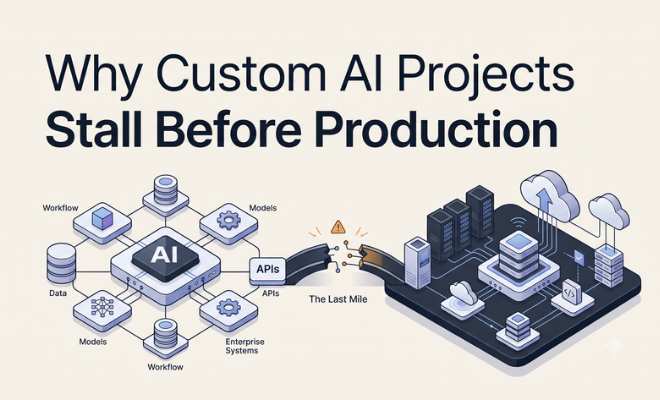
MIT researchers reviewed 300 enterprise GenAI deployments and found 95% delivered no measurable financial return. The gap wasn’t the model. It was everything after the pilot.
Why do custom AI projects stall before reaching production?
Custom AI projects stall before production because the requirements for running AI reliably at scale, governance sign-off, ownership structure, data hardening, ongoing monitoring, are fundamentally different from what a pilot needs to prove technical feasibility. Most project plans budget time and staffing for the pilot phase only.
KEY TAKEAWAYS
- The failure rate is well documented and larger than most executives expect. MIT’s NANDA initiative, in its 2025 “State of AI in Business” report, reviewed over 300 public enterprise GenAI deployments and found 95% delivered no measurable P&L impact; only about 5% reached production with measurable value.
- The bottleneck is integration and organizational readiness, not model quality. MIT’s researchers attributed the gap to a “learning gap,” tools and organizations that don’t retain feedback, adapt to workflows, or integrate deeply, rather than to model performance or regulation.
- Partnership structure changes outcomes substantially. MIT’s data found pilots blending internal specialists with external implementation expertise succeeded at meaningfully higher rates than internal-only builds, while budget allocation skewed toward high-visibility sales and marketing pilots even though back-office automation showed stronger returns.
- Scale timelines differ sharply by company size. Large enterprises in MIT’s dataset averaged roughly nine months to scale a pilot, versus about 90 days for mid-market firms, a gap tied directly to how production requirements get sequenced.
There’s a specific moment in almost every custom AI initiative where momentum disappears. The pilot impressed everyone. Leadership approved scaling it. Then, months later, it’s still “in progress” with no firm production date, and a growing list of reasons why it isn’t quite ready. The model that worked in the pilot still works. What stalled is everything the pilot never had to account for.
Where the stall actually happens
1. Ownership fragments the moment it matters. A pilot usually has one team, one sponsor, one success metric. In production, ownership splits across IT, security, the business unit, and often an implementation partner. When a decision is needed, like whether a borderline AI output routes to a human, there’s frequently no single person with authority to decide quickly, and the project’s velocity drops without anyone deciding to slow it down.
2. The data that worked in the pilot wasn’t representative. Pilots often run on data that’s been implicitly curated. Production data includes edge cases and malformed records the pilot never encountered, and models that performed well in testing degrade when they meet that data for the first time.
3. Governance gets scoped too late. Security and compliance review for AI systems touching customer or regulated data takes real time that’s rarely built into the original timeline. MIT’s finding that generic, high-adoption tools stall the moment workflows demand context and customization reflects this pattern directly: the tools that survive are the ones built and reviewed for the actual production workflow from the start, not adapted to it after the fact.
External anchors: MIT NANDA, “The GenAI Divide: State of AI in Business 2025,” July 2025.
A framework for reaching production
1. Scope production requirements before the pilot starts, not after it succeeds. Security, compliance, and IT operations should review the intended production architecture during pilot planning, even if formal sign-off comes later.
2. Test against real, unfiltered data as early as possible. If the pilot only sees curated data, budget explicit time to validate against production-representative data before claiming readiness.
3. Assign a single accountable owner for production, distinct from the pilot sponsor if necessary, with actual authority to make operational decisions once live.
4. Build the maintenance and monitoring plan into the initial business case. Include model monitoring, retraining cadence, and support escalation paths, not as a follow-up conversation once the pilot is declared a success.
5. Run governance and technical work in parallel, not sequentially. Security review shouldn’t wait for the pilot to finish.
6. Define the human-in-the-loop model explicitly before go-live: which decisions the AI can make unsupervised, which require review, and who reviews them.
Is your organization ready to scale a pilot?
| Criteria | Readiness signal |
| Pilot data source | Curated or sampled data only: budget time to test against full production data before scaling |
| Ownership | No single accountable owner defined for production: assign one before go-live, not after an incident |
| Governance timeline | Security/compliance review not yet scoped: this typically becomes the critical path if left until after the pilot |
| Implementation model | Internal-only build with no external implementation partner: MIT’s data shows this correlates with lower success rates |
| Budget allocation | Budget scoped for pilot only, no line item for ongoing monitoring and maintenance: revisit before declaring the pilot a success |
| Human-in-the-loop definition | Escalation path for borderline outputs undefined: this needs to exist before the first live incident, not during it |
Five mistakes worth naming directly
1. Mistaking pilot success for production readiness. The pilot is the visible, demoable part of the project, which creates pressure to declare victory and move on, even though the harder governance and ownership work hasn’t started.
2. Outsourcing the ownership question to the vendor. No implementation partner can resolve who inside your company owns the decision to escalate a borderline AI output. That has to be settled internally.
3. Over-indexing budget on visible, high-adoption use cases. MIT’s finding that sales and marketing pilots attracted disproportionate investment despite back-office automation showing stronger returns points to a broader pattern: visibility and ROI aren’t the same thing, and budget decisions built around the former stall the projects with the better business case.
4. Skipping the parallel-track governance review. Treating compliance sign-off as a final gate rather than a workstream that starts with the pilot creates a bottleneck exactly when the project should be accelerating.
5. Building for the pilot’s timeline, not the production timeline. MIT’s roughly nine-month scaling average for large enterprises versus 90 days for mid-market firms suggests the gap isn’t AI capability, it’s how early production requirements get planned into the project.
A decision framework
Custom AI projects that reach production on a reasonable timeline treat the pilot as a technical feasibility check and treat production readiness as a separate, parallel-tracked workstream with its own owner, timeline, and budget. They involve security and compliance early enough that sign-off is a formality rather than a discovery process, and they define success as “the organization can run this reliably” rather than “the model works.”
ETS Labs structures contact center AI deployments, including QEval and Process Automation, around defined implementation windows rather than open-ended pilots, specifically because a bounded timeline forces the governance and ownership questions to surface early, when they’re cheap to resolve. More at etslabs.ai/professional-services.
Frequently asked questions
What percentage of enterprise AI pilots actually reach production?
MIT’s NANDA initiative found roughly 5% of the 300+ enterprise GenAI deployments it reviewed reached production with measurable financial impact; 95% did not.
Is the 95% failure rate about bad AI models?
No. MIT’s researchers attributed the gap primarily to a “learning gap,” tools and organizations that don’t adapt to workflows or retain feedback, rather than to model quality or regulatory barriers.
Does using an external implementation partner actually improve outcomes?
MIT’s data found pilots combining internal AI specialists with external implementation partners succeeded at meaningfully higher rates than internal-only builds.
How long should scaling from pilot to production take?
MIT’s dataset showed large enterprises averaging roughly nine months, compared to about 90 days for mid-market firms. The gap tracks closely with how early production requirements, governance, ownership, and monitoring, get planned into the project.
What’s the single biggest predictor of a stalled AI project?
Undefined ownership for production decisions. When there’s no clear, accountable owner for operational calls once the system is live, decisions queue up and momentum stalls even without anyone explicitly pausing the project.

Related Posts
How Much Does Custom Software Development Cost? A Realistic 2026 Breakdown
What does custom software development cost in 2026? See the real cost drivers, pricing models,…
Read More
Contact Center AI: Strategic Decisions Your Organization Must Make
Six strategic decisions contact center leaders must make before choosing AI, from outcomes and augmentation…
Read More
Automated Quality Management Explained: Building QA Programs That Scale
Manual QA covers 3-5% of calls. Automated quality management covers 100%. See how contact centers…
Read More